Quick Facts
- Common Cause: Most elbow issues in the gym are driven by sudden spikes in training volume or poor load management rather than a single traumatic event.
- The 7-Day Rule: If modifying your grip and reducing weight doesn't yield improvement within one week, it is time to consult a physical therapist or sports physician.
- Clinical Prevalence: Research shows that the elbow is the second most common site of injury for elite powerlifters, representing 11.2% of all reported acute and overuse injuries.
- Primary Rehab Method: Eccentric loading using a 3:0:3 tempo is the gold standard for remodeling tendon tissue and reducing chronic pain.
- Technical Fix: Transitioning to a neutral grip (palms facing each other) and improving scapular stability are the fastest ways to reduce immediate joint inflammation.
- Injury Incidence: In strength sports, athletes typically face an injury rate of 1.0 to 4.4 injuries per 1,000 hours of training, with the elbow and upper arm being primary hotspots.
Weightlifting elbow pain, often caused by lateral or medial epicondylitis, typically stems from overuse, poor form, or sudden increases in training volume. To alleviate strain, lifters should focus on adjusting grip width, ensuring neutral wrist alignment, and incorporating eccentric loading exercises to strengthen the tendons. Dynamic warm-ups and soft tissue mobilization also help prepare the joints for heavy loads.
Identifying Your Pain: The Three-Zone Map
Before you can fix the problem, you have to know what you are dealing with. In the world of sports performance, we categorize weightlifting elbow pain into three distinct zones. Each zone points to a specific tendon or mechanical failure that requires a unique corrective approach.
The first zone is the Inner Elbow, professionally known as Medial Epicondylitis or Golfer's Elbow. If you feel a sharp or dull ache on the inside of your elbow when performing heavy rows, pull-ups, or bicep curls, this is your culprit. It is usually an issue with the flexor tendons of the forearm.
The second zone is the Outer Elbow, known as Lateral Epicondylitis or Tennis Elbow. This manifests on the bony bump on the outside of the joint. It is incredibly common in lifters who over-rely on their grip during deadlifts or use excessive wrist extension during pressing movements.
The third zone is the Back of the Elbow, which usually indicates Triceps Tendonitis. This is characterized by pain right above the "point" of the elbow during lockout on bench press or overhead extensions. While these are the primary musculoskeletal issues, you must watch for red flags. If you experience tingling or numbness in your pinky and ring fingers, you might be dealing with Cubital Tunnel Syndrome, which involves nerve compression rather than simple joint inflammation. Identifying these nuances early is the difference between a two-week deload and six months on the sidelines.
Immediate Technical Fixes: Modification Over Cessation
The biggest mistake most lifters make is stopping all upper body training the moment they feel a twinge. Total rest often leads to tendon deconditioning. Instead, we use the philosophy of modification over cessation. We want to keep the tissue loaded but change the mechanics to reduce the shear force on the sensitive areas.
One of the most effective changes is how to adjust grip width to reduce elbow strain. In movements like the bench press or overhead press, a grip that is too narrow often forces the elbows to flare or the wrists to cock back, placing massive stress on the medial epicondyle. Moving your hands out one or two inches can create a more vertical forearm angle, which better distributes the load through the shoulder and triceps.
Another vital adjustment involves proper lifting form for elbow health by maintaining a neutral wrist. Whether you are curling or pressing, your wrist should remain a straight extension of your forearm. If your wrist collapses backward during a bench press, you are essentially turning your forearm tendons into a bridge under high tension. Using lifting straps for heavy pulling movements can also bypass the grip-related tendon load, allowing your back to work without taxing your inflamed forearm extensors.
| Exercise | Common Pain Trigger | Safer Alternative |
|---|---|---|
| Barbell Bench Press | Excessive elbow flare/wrist extension | Floor Press (limits range of motion and flare) |
| Straight Bar Curls | Fixed wrist position causing inner strain | EZ-Bar Curls or Neutral Grip Dumbbell Curls |
| Skull Crushers | High shearing force at the triceps tendon | JM Press or Cable Pushdowns |
| Pull-ups | Excessive strain on forearm flexors | Neutral Grip Chin-ups or Lat Pulldowns |
The Recovery Protocol: Isometrics to Eccentrics
If your weightlifting elbow pain has moved past a minor annoyance into a chronic issue, you need a structured rehab protocol. We follow a three-phase approach grounded in sports science.
Phase 1 focuses on pain management through isometric exercises. Isometrics have a known analgesic effect, meaning they can actually dull the pain signal. Try a "Palms-Up Isometric Hold" for the inner elbow or a "Palms-Down Isometric Hold" for the outer elbow. Hold a light dumbbell at a 90-degree elbow angle for 30 to 45 seconds. This provides a stimulus to the tendon without the irritation of movement.
Phase 2 addresses the "Joints Above and Below" philosophy. Often, elbow pain is actually a shoulder or wrist problem. If your shoulders lack internal rotation or your scapular stability is poor, your elbow is forced to compensate to keep the bar on the correct path. Incorporating face pulls and "Scapular Pull-ups" ensures that the larger muscle groups are doing the heavy lifting, sparing the smaller elbow joint.
Phase 3 introduces eccentric loading exercises for elbow tendonitis recovery. Tendons respond best to slow, controlled lengthening under tension. Use a 3:0:3 tempo: three seconds down, no pause at the bottom, and three seconds back up. For the outer elbow, use a dumbbell wrist extension where you use your "good" hand to help lift the weight, then slowly lower it with the affected side over three seconds. These rehab exercises for medial epicondylitis from lifting help remodel the collagen fibers in the tendon, making them more resilient to future heavy loads.
Long-Term Prevention: Warm-ups and Volume
Prevention is always more efficient than rehabilitation. The elbow is a hinge joint caught between the high-mobility shoulder and the high-utility hand. To protect it, you must manage your training volume to prevent tendon overload. Tendons have a lower blood supply than muscles, meaning they take longer to adapt to weight increases. If you add 20 pounds to your bench press in a week, your muscles might handle it, but your tendons might not.
A dedicated dynamic warm up for elbow health weightlifting should be a non-negotiable part of your routine. Instead of just doing a few light sets of your first exercise, spend five minutes on soft tissue work. Use a lacrosse ball or foam roller on your forearms and triceps to break up adhesions. Follow this with "wrist circles" and "elbow rotations" to move synovial fluid into the joint.
Finally, respect the signs you should stop lifting due to elbow pain. There is a difference between "good" muscle soreness and "bad" joint pain. If your pain is sharp, stays local to the bone, or gets worse as the set progresses, stop that specific movement immediately. Incorporating a deload phase every 4 to 6 weeks—where you reduce your total training volume by 30-50%—gives your connective tissues the window they need to recover. Statistics indicate that approximately 11% of all musculoskeletal injuries in weightlifting involve the elbow, but most of these are preventable with smart volume management and proactive care.
FAQ
Why do my elbows hurt when I lift weights?
Weightlifting elbow pain is usually caused by repetitive stress on the tendons that connect your forearm muscles to the elbow joint. This often happens due to a sudden increase in training volume, poor lifting mechanics like "flaring" the elbows, or using a grip that places the wrist in an awkward position. Over time, these small stresses lead to micro-tears and inflammation known as tendonitis or tendinopathy.
How do I treat weightlifter's elbow at home?
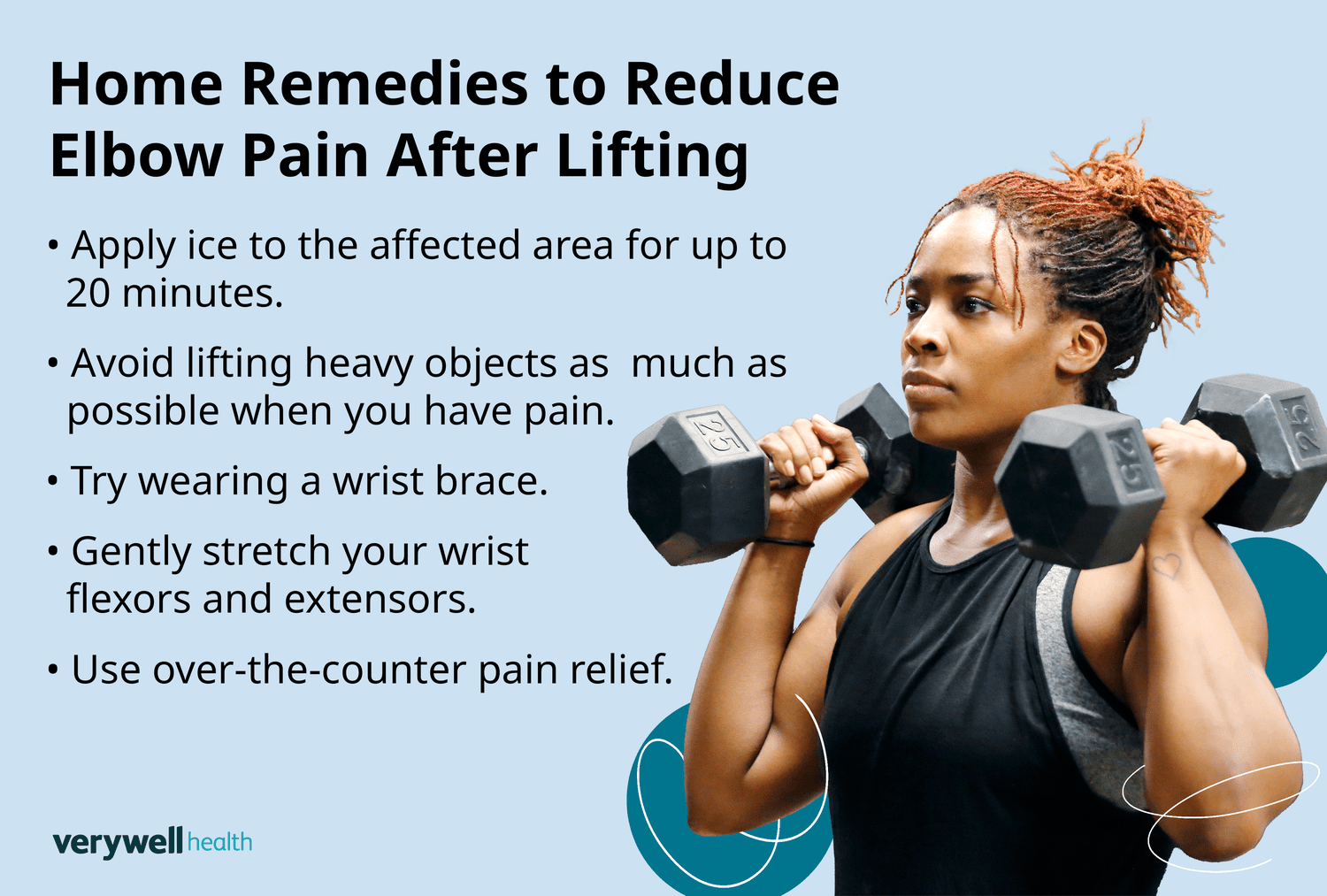
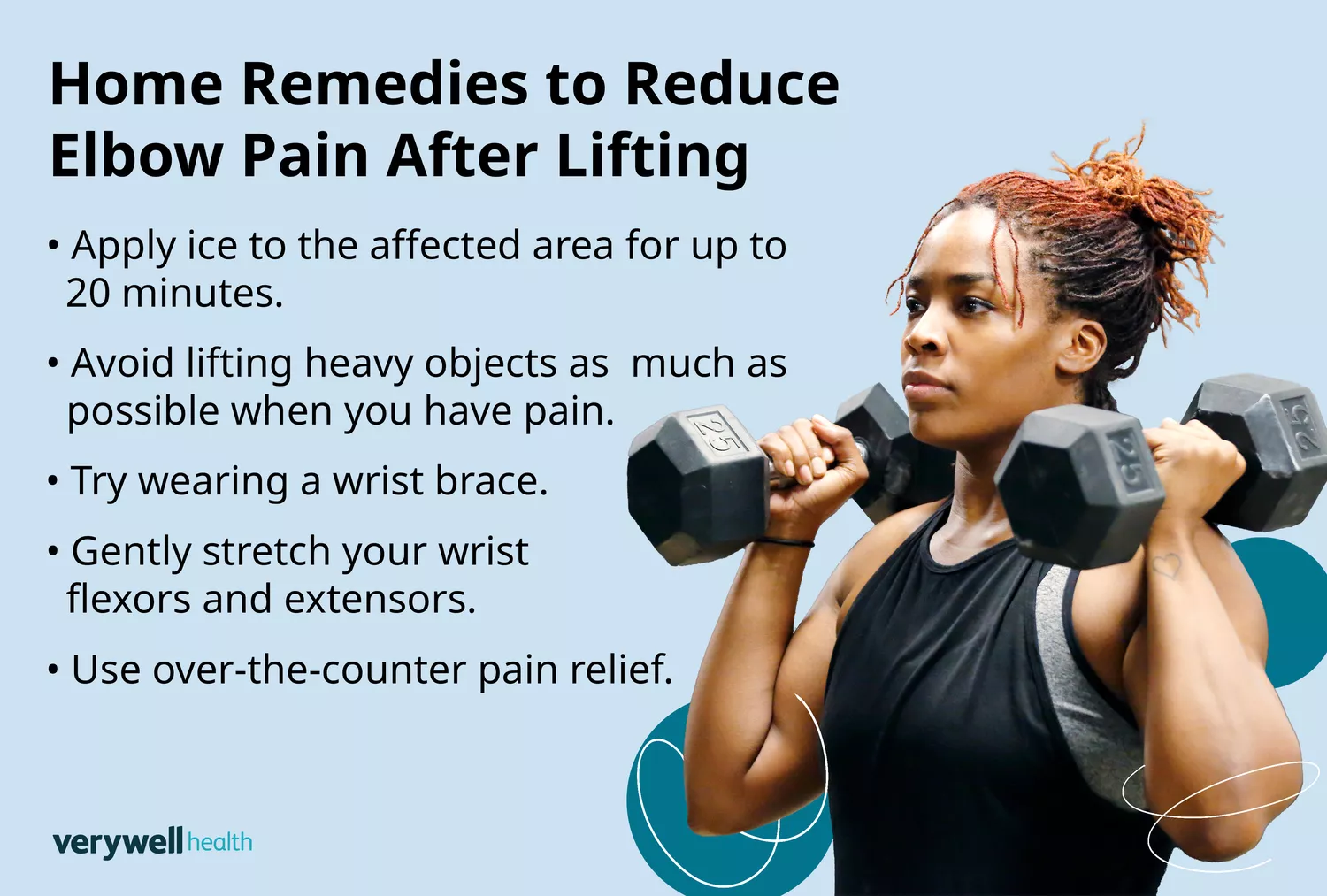
Effective home treatment starts with the RICE method (Rest, Ice, Compression, Elevation) during the first 48 hours of acute pain. Beyond that, focus on soft tissue mobilization using a massage ball on the forearm muscles and implementing isometric holds to reduce pain. Switching to a neutral grip during daily activities and using corrective exercises for elbow pain like slow eccentric wrist curls can significantly speed up recovery.
Should I stop lifting if I have elbow pain?
Not necessarily. Total inactivity can actually make tendons stiffer and weaker. The goal should be "active recovery." You should stop any specific movement that causes a pain level higher than a 3 out of 10. Replace painful exercises with safer alternatives, such as switching from a barbell to dumbbells or using a reduced range of motion, while you work through a rehab protocol.
How can I prevent elbow pain during bench press?
To protect your elbows during the bench press, focus on keeping your tucked elbows at roughly a 45-degree angle to your torso rather than letting them flare out 90 degrees. Ensure your wrists are stacked directly over your elbows and not bent backward. Additionally, strengthening your upper back and improving scapular stability will help provide a solid base, reducing the stability burden on your elbow joints.
Do elbow sleeves help with weightlifting pain?
Yes, elbow sleeves are highly effective for managing weightlifting elbow pain. They provide compression, which helps reduce swelling and increases blood flow to the area. They also keep the joint warm, which improves the elasticity of the tendons and ligaments. While they aren't a "cure" for poor form, they are an excellent tool for providing extra support during heavy lifting sessions.